
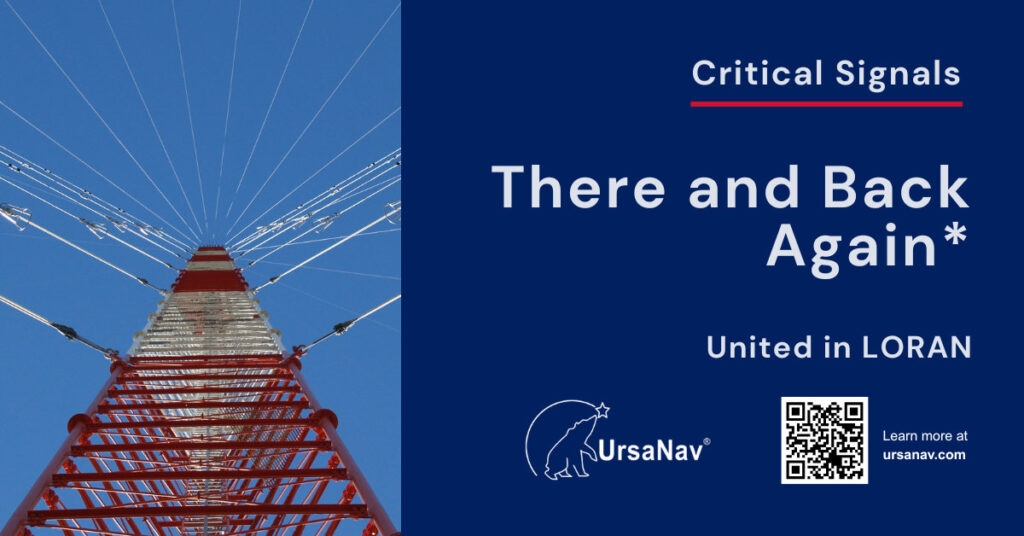
Critical Signals: There and Back Again*
United in Loran
In the early 1940s, the UK and US worked on “Most Secret” and “Top Secret” programs that subsequently resulted in systems known as Loran. The UK efforts took place in and around Malvern, Worcestershire, and the US efforts were centered in and around Boston, Massachusetts. Eighty-six years later, these same two areas are at the forefront of developing the future of Loran.
QinetiQ UK’s current office in Malvern and UrsaNav’s office in North Billerica, MA, will now continue the long history of cooperation between the two regions: In the US, it was the MIT Radiation Laboratory (Rad Lab) and Harvard’s Radio Research Laboratory (RRL) that provided early work on Loran. In the UK, it was QinetiQ’s predecessors, the Telecommunications Research Establishment (TRE) and Air Defence Research and Development Establishment (ADRDE), that brought us GEE, the world’s first application of a hyperbolic navigation system. GEE then evolved over many decades to become eLoran.
Given all this history, it should come as no surprise that a team led by QinetiQ has recently secured a multimillion-pound contract from the UK Ministry of Defence (MOD) to create a deployable solution concept based on eLoran. Team Elaris—a name combining “eLoran” and “arise”—unites QinetiQ, UrsaNav, Roke, and GMV to deliver this new resilient positioning, navigation, and timing (PNT) concept for the UK MOD “Urgent Compass” programme.

Delivered over two years, the effort will lay the foundation for future demonstration, production, and large-scale deployment of eLoran-based systems designed for operations in contested and denied environments.
Modern military missions depend critically on reliable PNT. While global navigation satellite systems (GNSS) are often the backbone of these capabilities, these systems are increasingly vulnerable to jamming, spoofing, and meaconing by adversaries. In high-threat environments, compromised PNT signals can degrade operational effectiveness, disrupt coordination, and jeopardize mission success.
This programme directly addresses these challenges by advancing eLoran—a powerful terrestrial wireless alternative that delivers robust, independent PNT resilience when satellite signals are unavailable or unreliable. Designed with rapid deployment in mind, the solution will enable assured navigation and timing across a wide range of operational scenarios worldwide.
Bringing together deep technical expertise in resilient PNT, the team will evaluate both deployable and fixed eLoran architectures, ensuring flexibility across mission sets and geographies. The initiative represents a critical step toward strengthening layered PNT strategies and reducing dependence on vulnerable space-based systems.
*with a nod to J.R.R. Tolkien’s The Hobbit.