
Critical Signals: Fixed, Deployable, or Both? Choosing the Right eLoran Strategy
Loran has included tactical applications since the 1960s. Early examples included U.S. deployment of manned, air-deployable transmission sites in Southeast Asia. These systems relied on fixed antenna structures to achieve the required wide-area coverage. Other programs adapted “antennas of opportunity,” including legacy radio beacon, AM broadcast, and very low frequency (VLF) infrastructure. The Anthorn, UK site, for example, uses a “Tee” antenna suspended between two masts originally built for a VLF system. The U.S. Department of Defense (DoD) also fielded deployable concepts using tethered aerostats, while some projects employed quick-erect masts for shorter-range missions.
From the beginning, tactical Loran systems reflected a balance between coverage, portability, infrastructure, and mission requirements.
The Evolution from Fixed Systems to T3
Early Loran systems were large, fixed installations by necessity, designed to meet demanding technical performance requirements. Advances in transmitter, antenna, and control technologies gradually enabled smaller, more portable solutions with advantages for specific operational needs. These developments led to modern tactical, temporary, and transportable (T3) systems.
Today, both fixed and deployable systems remain relevant because they solve different problems and can perform well with different inputs.
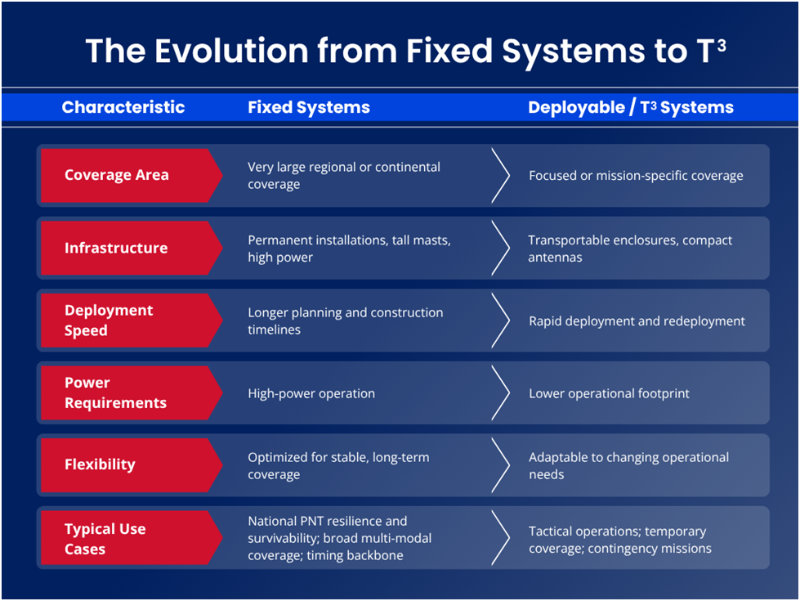
Several nations are evaluating a mixed approach: fixed systems for broad regional coverage, deployable systems for targeted operational needs, and combinations of both where mission requirements demand flexibility.
Experience Across the T3 Spectrum
Our personnel have worked with several T3 Loran and eLoran systems over the years.
We supported, and later replaced, the Air Transportable Loran System (ATLS) at the former Loran-C transmission site in Lampedusa, Italy. We worked with the U.S. Air Force tactical Loran-D system, which included configurations that used tri-tethered aerostats to elevate transmit antennas. We served as a subcontractor on the triple-CONEX box solution currently deployed at the Anthorn, UK eLoran site.
We also designed, developed, deployed, and operationally tested a prototype T3 solution for the U.S. Army, and contributed to two “mini-chain” Loran-C implementations: one along the Saint Lawrence Seaway and another supporting the Suez Canal region.
Our current T3 transmission system combines a transportable transmitter, eLoran signal generation, monitoring, and control capability with a purpose-built transmit antenna. The system has been deployed and redeployed in Canada, multiple U.S. locations, and Germany.
A Practical Example: Fixed and T3 Working Together
A hybrid architecture can provide compelling operational benefits.
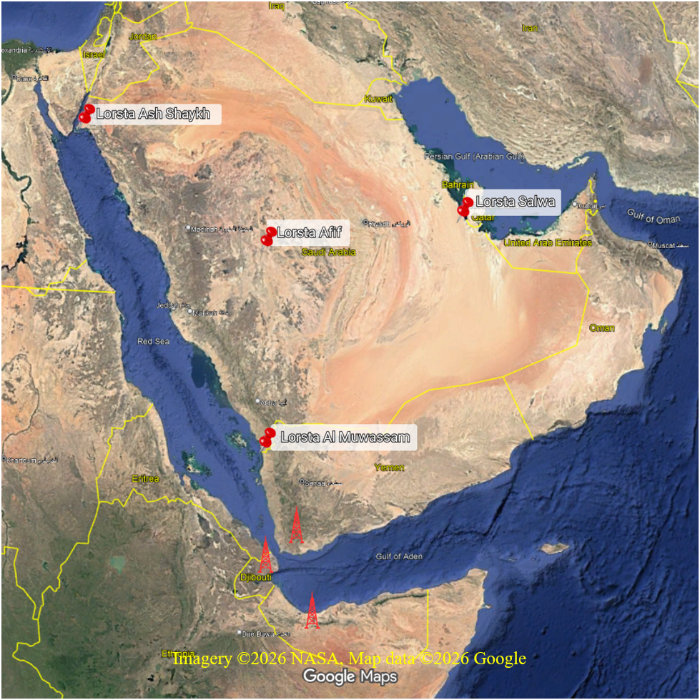
Consider the Middle East. The Kingdom of Saudi Arabia operates eLoran transmission sites at Afif, Salwa, Ash Shaykh Humayd, and Al Muwassam. Complementing this fixed infrastructure with representative T3 deployments in the Red Sea and Gulf of Aden region could extend high-quality positioning coverage through the Gulf of Aden, across the Bab el-Mandeb Strait, and into the Red Sea.
Deployable sites in locations such as Djibouti, Yemen, and Somalia could provide positioning accuracies better than 10 meters in key operational areas. At the same time, users could benefit from reception of high-power signals from fixed Saudi sites, particularly Al Muwassam and potentially more distant transmitters such as Salwa and Afif.
This example illustrates an important point: Fixed and deployable systems are not competing solutions. In many environments, they are complementary capabilities.
Build the Right eLoran Architecture for Your Mission
There is no universal answer to PNT resilience. The optimal architecture depends on geography, operational objectives, coverage requirements, deployment timelines, infrastructure constraints, and long-term sustainability considerations.
Whether your use case calls for fixed infrastructure, a deployable T3 capability, or a hybrid approach, selecting the right technology strategy matters.
UrsaNav has experience across the full spectrum of Loran and eLoran implementations, ranging from legacy tactical systems to modern T3 solutions. If you are assessing resilient PNT options, consult with our team to identify the technology and architecture best aligned with your operational requirements. Contact us at Info@UrsaNav.com.