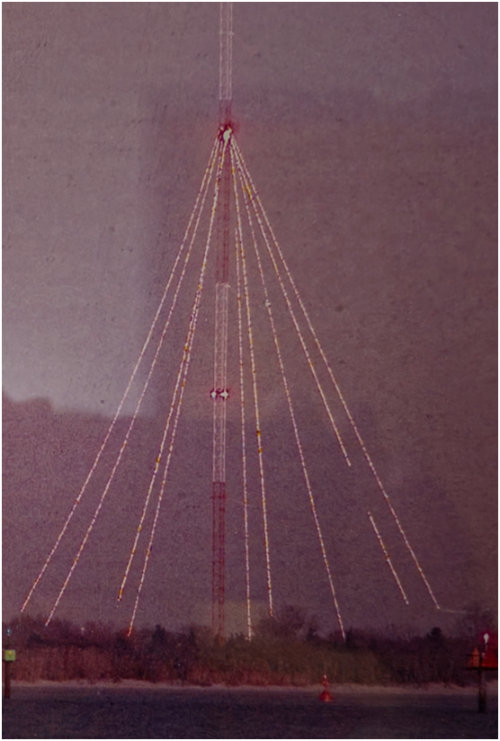

A Tower Falls, a Legacy Continues: Remembering the Wildwood Loran Site
On August 14, 2026, UrsaNav helped mark a moment in maritime history as Founder and CEO Charles “Chuck” Schue came full circle, concluding a chapter that began almost three decades ago with his service in the U.S. Coast Guard (USCG) Loran Support Unit (LSU) in Wildwood, New Jersey.
As the first commanding officer of the LSU, Chuck was honored to attend the demolition of the 625-foot Loran transmitting antenna located at the site. Also in attendance was Gary Thomas, the LSU’s last commanding officer. Together, Chuck and Gary represented the military personnel, civilians, and contractors who served our nation and the international Loran community at the site over the decades.
The LSU occupied the southernmost portion of the former Coast Guard Electronics Engineering Center (EECEN), which closed on August 1, 1997. The approximately 1,300-acre site, including roughly 1¼ miles of beachfront, is located adjacent to the Atlantic Ocean on Two Mile Beach, just north of Cape May, New Jersey. Thanks to the USCG’s stewardship, the property remains an unspoiled section of the mid-Atlantic seashore, in near-pristine condition.
The LSU performed systems management and engineering support functions for Loran programs worldwide. Its staff designed, developed, and deployed technology supporting Loran and Enhanced Loran (eLoran) systems in North America, Europe, and Asia.
After the United States terminated its Loran-C program in 2010, UrsaNav continued developing and deploying Loran-C and eLoran technologies around the world. Under Chuck’s leadership, UrsaNav has operated various former U.S. Loran-C sites under contracts with the USCG as well as the Departments of Homeland Security, Transportation, and Defense, since 2012.
For those who attended the event in August, watching the tower fall was bittersweet.
On one hand, it marked the end of an era for an antenna that stood at the southern tip of Two Mile Beach since July 1958. On the other, its removal represented the final step in transitioning the site from the USCG to the U.S. Fish and Wildlife Service (USFWS).
The USCG had long intended for the property to ultimately transfer to the USFWS to ensure the site would be preserved in support of its mission to conserve, protect, and enhance fish, wildlife, plants, and their habitats for the continuing benefit of the American people. The team at the Cape May National Wildlife Refuge hosted the August event as part of that transition.
The transfer represents the second phase of a process that began in the late 1990s, when EECEN closed. At that time, approximately half of the center’s property was transferred to the USFWS, while the remainder was retained to establish the LSU.
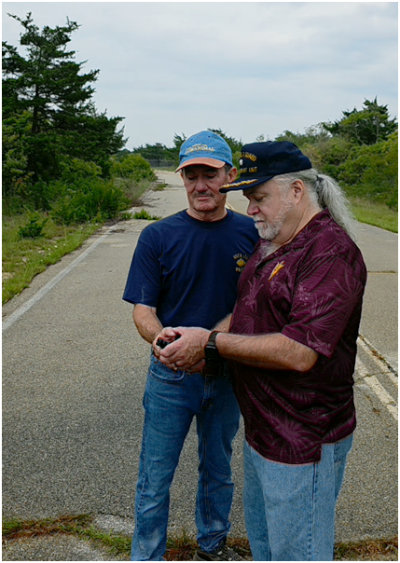
Just as the USCG and LSU were at the forefront of Loran development, engineering, and operations, UrsaNav continues that innovative work today with a team that includes several retired members of the Loran community who share the same passion and dedication.
The antenna felling was conducted by Celnet, RMC, CDI, and KJP, and led by prime contractor Northern Pride Communications under contract with the USCG.
For history buffs, it’s worth noting that the antenna was the oldest standing Loran antenna in the world. Its most recent operation was in 2021, when UrsaNav used the antenna while conducting experiments under contract with the Department of Defense. Over its decades of service, the antenna transmitted Loran-C, Loran-D, eLoran, and LFPhoenix®. It was also used on several occasions by amateur radio enthusiasts for contests.
The tower may no longer stand at Two Mile Beach, but the work it supported—and the expertise developed by the people who served there—continues.